Tell me, does it get sweeter than this? The big handsome kid gliding to the glass in warmup drills, that's your son. He's the best high school player in the city. One look at the visitors, who've come from 40 miles away, tells you all you need to know: He's the best player in the house tonight.

Had Jim Jr. (left, with Rob) been in Jonestown at the time of the mass suicide, he likely would have died.
Robert Beck/SI
Better still, your two brothers are in town, right beside you. All three of you grew up together on a basketball court. All three of you were starters on the same team. You can see it on their faces. They're reliving it too.
Everyone filing in, it seems, calls or waves to you, the friendly father of the star. Your kid looks up and gives the slightest nod. He's dedicating this game to your side of the family. Got to love that too.
You all rise for The Star-Spangled Banner. Then your son and the other team's big man crouch at midcourt for the tap. Your eyes, like your brothers', like your son's, lock on the basketball. As if you owed your lives to that thing. Which all four of you do.
O.K., there's something else going on here. The kid's dedicating this game to your sister -- his aunt, Suzanne -- who just died of colon cancer. No, not a pretty way to die, but more dignified than face-down in the mud on the edge of a South American jungle, like your mother, father, wife, unborn child, two brothers, a sister, four nephews and a niece.
None of you here tonight should exist. Not you, Jim Jones Jr., the one who carries that name. Not your brother Stephan, the one who carries that blood. Not your brother Tim, the one who carries the visual memory of your relatives and friends among the 910 bloated bodies lying shoulder-to-shoulder, the largest mass suicide in modern history.
And no, not your son down there, the Reverend Jim Jones's grandson.
You were spared that day: Saturday, Nov. 18, 1978. You, Stephan and Tim were teenagers, 150 miles away, playing against Guyana's national basketball team. You were saved by this sport.
But then... if you hadn't been away that day, maybe you could've stopped it. Maybe you'd have stood up to your father when he ordered everyone in the Peoples Temple to drink the cyanide-laced powdered grape punch in Jonestown, Guyana. Maybe you could've saved your family, saved everyone. You were cursed by this sport.
His son controls the tap. Archbishop Riordan High begins to run a play. Jim Jones Jr. looks around the gym. This is the last place he dreamed he'd be in his mid-40s, in December 2006. This is the last sport his child was supposed to play.
The kid misses a four-footer, gets whistled for climbing a defender's back on a rebound, then flings a pass out-of-bounds -- all before the game, against San Ramon Valley in the final of the Crusader Classic, is 45 seconds old. Focus it, thinks Jim. Focus that fire
His son knows how much Suzanne meant to Jim upon his return from the massacre. Knows that a game's more than a game. He barrels in for three layups, then slashes across the lane and feathers in a turnaround jumper, igniting Riordan to a 17-8 lead. He's settling down now, becoming who he is: RobJones, San Francisco's reigning high school player of the year. RobJones, the kid who keeps that loaded last name glued to his first one so that nobody will ever lose sight or sound of it.
Who would he be now if he didn'tknow? Yes, this had been the million-dollar question for Jim and his surviving siblings after their children were born: Would they tell the kids of the horror, and of their relation to one of the most diseased men and moments in U.S. history? Would the next generation of Joneses have to carry the stain?
Jim glances at Suzanne's two adult children, cheering for their cousin. Only on her deathbed, a few months ago, had Suzanne disclosed her family history, though she'd dropped out of the Peoples Temple long before its hasty flight from San Francisco to the jungles of Guyana in 1977. Surely Jim could've tried to quash his past too. Could've started life over far from the Bay Area, the cult's home base, and disowned the legacy, sealed it from his three sons. Jones, after all, was the fourth most common name in the U.S., and he, unlike the notorious father who had adopted him and made him his namesake, was black.
But Jim's an extrovert, the life of the party, not the keeper of secrets: a lousy vault. Hell, he'd named Rob, his firstborn, after the father of his teenage wife, Yvette Muldrow, who'd drunk the cyanide and died along with their unborn baby. When Rob was a toddler, Jim marked the anniversary of Yvette's death by taking him to the mausoleum where her ashes are interred and letting him play while Jim sat near the urn, devoured by shame that he was alive and she wasn't . . . because of a game.
He knew that one day he might have to pass on his story to his son. But how could he ever pass on his game?
Wait a minute. Where's Jim? He's not sitting with his brothers in the upper section anymore. He's down in the lower section, beside his wife, Erin. He winces as his son misses a chippy, outmuscles everyone for a putback that misses as well, and then, dammitall, goes up again... yes! Jim raises his fist as Rob takes a feed a moment later and slams. The kid's 6' 5 1/2", 230, a furniture truck with springs and speed.
But Jim remembers the pipsqueak he could lift overhead. Back when he still thought he had plenty of time to figure out how and what he'd tell his son; hell, the kid was only four...
... when Waco happened. A 51-day FBI siege of another sect -- the Branch Davidians in Waco, Texas -- that left 82 dead in 1993 and kept TV commentators harkening back to the last American cult horror: Jonestown. "Jonestown?" echoed little Rob in front of the TV. "There's a town named after us? I want to go there!"
Oh, God. For 15 years Jim had been going there and fleeing there in his head, and finally -- he'd thought -- found refuge, a nice numb little cove. At first, of course, that had been impossible. A Secret Service agent, a customs agent and a Treasury agent were assigned to him and each other player on their way home to the U.S. He'd been interrogated in an airport hangar the moment he'd set foot in America, then placed under police surveillance for months while he lived in Suzanne's Bay Area apartment. For weeks he'd been mobbed by reporters on his way in and out of federal courthouse hearings on the Jonestown tragedy, splashed across San Francisco newspapers and, when people pointed at him in malls, made to feel like a leper. He was 18 years old.

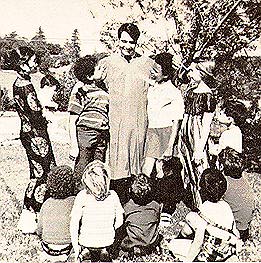
Marceline and Jim Jones adopted Jim Jr. (top row, far right) and six other children of various ethnicities.
Don Hogan Charles for the New York Times 1976 / Getty Images
He'd swallowed his fears and shown up at a half-dozen funerals for temple members whose bodies had been shipped back to the Bay Area. Then the mother of one of the dead, at a post-funeral gathering, put a gun to his head and hissed, "Why should you be alive when my daughter's dead?"
"I don't want to be alive," Jim replied. "Kill me now."
Mourners grabbed the gun and gave him some advice: Stay away from the survivors; they'll blame you. Hell, he blamed himself, mostly for having sent Yvette, the pregnant bride who had wanted to stay at his side, back to Jonestown a few weeks after their wedding in Georgetown while he remained in the Guyanese capital to do public relations and liaison work for Jonestown's economic and outreach projects, including the basketball games against the host country's Olympic team.
"So you're Jim Jones, huh?" said his boss at his first job in his new life, as he prepared to head out on his route as a bank courier. "You going to pick up some Kool-Aid on your drive tonight?"
"That's not funny," said Jim. "That's my father."
"What?"
"That's my father."
"You can't be serious. Jim Jones was white."
"I was adopted by him."
His boss looked at him and said, "You're fired."
The stain was deeper than Jim had feared. He tried college but quickly dropped out. Too much mind static. He tried the office-furniture delivery business alongside brothers Tim and Stephan and former Jonestown teammate Johnny Cobb. He tried Buddhism, Islam, Pentecostalism and Catholicism. He tried Telisa and Alice and Danette, hasty engagements to three tall, light-skinned, curly-haired African-Americans born under the sign of Scorpio... just like Yvette. He became the last thing that his socialist father could've imagined: a Republican.
Why not a new identity -- or his original one? He considered changing back to his birth name. He settled on James Jones, safe but not a lie, and winced through 11 years of Kool-Aid jokes from people who never dreamed that a man so likable, a black man, could be the mega-killer's son.

As a freshman forward Rob (22) averaged 23 minutes and 6.3 points in San Diego's first 13 games this season. Robert Beck/ SI
Then one day in 1989, after he'd gotten a two-year degree in respiratory therapy from California Pacific College and gone from hospital orderly to respiratory therapist to director of cardiopulmonary services at a San Mateo hospital, he stared at the name affixed to his new office door. Apparently all the certification initials listed after his name -- CRT, CPFT, RCP -- had made James Jones Jr. too long for his name plate, and someone had shortened it. To Jim Jones Jr.
No, he thought. People would find out. He'd have to have that changed.
Something stopped him. Jim Jones Jr. was who he was. Sure, it would be risky. The woman he loved, a neonatal nurse named Erin Fowler, had bolted from his car on their first date, just a few years earlier, when his relationship to the Rev. Jim Jones had spilled out of him. But she'd calmed down. Even married him.
He began introducing himself as Jim Jones and letting a few people know that he was the cult leader's son. The dispassion with which he spoke of it sometimes perplexed them. But they'd marvel at the miracle that a man who'd lived through what he had could come out the other end as successful and affable as Jim. He felt a little better now, at least.
Two places remained off-limits. The first was the basketball court. The sport that had taken him away from where 24 members of his family had died still flushed him with guilt. The second place was inside himself. He refused psychotherapy. "The mind's a dangerous neighborhood," he'd say. "Don't go there unless you have to." He wouldn't, he couldn't disturb the buried pain, because then he couldn't be Jim, the charismatic guy with the deep, rich voice that boomed down hospital corridors. Besides, it was just too difficult to convey to a stranger, even a hired empathizer, what it felt like to be him. The closest he could come was this: Imagine there's a painting of you, he'd say, with the background all there, right behind you. And 20 years later, you're still there in the painting, but all the background's gone. There's nothing behind you. The people, the setting, your way of life and belief system -- gone.
He'd sink into depressions each November, the anniversary of the tragedy. He'd dream Yvette back to life, then watch her vanish each time he drew near. He'd dream that his father was coming after him. Then wake up, go to work and crack the Kool-Aid jokes himself. But now it was '93 -- with Waco on everyone's lips and Jonestown suddenly disinterred -- and the coworkers to whom he'd confided his past kept asking, "You O.K, Jim? You O.K.?"
"Are you O.K.?" he started snapping back. Something was bothering him, something stirred by Waco -- so many children, dead again -- something that he just couldn't reach. And now his child was asking about Jonestown. He could dodge it, keep the kid in the dark. But that carried an explosive risk too.
He swallowed hard and started in the shallow end. He started with the story of a minister and his wife entering an Indianapolis orphanage in 1961 to adopt a Caucasian baby girl, only to be distracted by a wailing 10-week-old African-American boy whose unwed mother, age 15, couldn't raise him. Jim told Rob what his adoptive mother had told him, how Jim had stopped crying the moment Marceline Jones lifted him into her arms, and how she and her husband decided right then to make him the first black child in Indianapolis ever adopted by a white couple, and to consecrate their belief in racial equality by giving him his father's name.
Jim tried to humanize that man with raven hair and sunglasses and the Chairman Mao cap. He told Rob about the gentle side of the Reverend Jim Jones, his hugs and kisses, his ability to make Jim Jr. feel unique, prized, chosen. Then one day Jim peeled an old family portrait from a scrapbook, framed it and placed it on the mantel. "See, Rob?" he said. "They called us the Rainbow Family. Seven of us eight kids were adopted, and we came from all over." He pointed to Agnes, an elder sister who was part Native American. Then to Suzanne and Lew, both adopted from Korea, and to Tim, a close family friend whom the Joneses ended up adopting as well. Then to Stephan, their one biological child. Then Jim told Rob about the two who weren't in the picture: Goldie, the eldest, who married and broke ties with the family before Jim was adopted, and Stephanie, another child adopted from Korea, who died in a car crash.
He told Rob about the adventures of the Rainbow Family, the years abroad in Brazil, Argentina and Hawaii, and the long caravan that formed in 1965 when Father -- as everyone in the church called Jim Jones Sr. -- led 70 Indiana families to the Peoples Temple's new home, a tiny hamlet in the vineyards of Northern California. About the orphanages his dad ran, the soup kitchens, free clinics and senior citizens' homes he opened, the theaters, restaurants and hospitals he desegregated. About his dream that their church would be the seed for a new world, one without barriers between rich and poor, races and sexes and ages.
Little Rob didn't need to hear the messy details. Not yet. Didn't need to know that it was Grandpa's raging paranoia that drove the Rainbow Family to Belo Horizonte, Brazil, and then to Redwood Valley, Calif. -- two sites listed in a 1962 Esquire article as among the likeliest to survive a nuclear holocaust. That it was his lust for greater power that sent the family and the temple to San Francisco in '72, and that it was published stories about his alleged abuse of church members that stampeded them to Guyana in '77.
The kid was way too young for that, and besides, Jim had learned something. When he spoke well of his father by day, his father stopped stalking his dreams at night.
Rob can feel it now. No one here can stop him. He whirls and powers through two defenders to score, giving Riordan a 30-19 halftime lead. But where's Jim?
That's him, slipping outside the gym and lighting a cigarette, sucking hard so he'll have time to light and suck a second one. Always dropping out of sight when he can't be the wonderful guy everyone knows. But no, it's nothing like it used to be, back when Rob was four, when Jim started heading out for work or an errand. . . .
... and vanishing. He would drive for hours, tearing at himself. Dammit, he'd been on his father's security team, protected him from danger. Walkie-talkies, earphones, weapons, code words, the works. He would park his car at the beach and pour from a bottle into a plastic cup, hoping vodka worked as a solvent on the stain. He'd skulk back home, wrung out and ragged, a day or so later.
Waco had started the slide, then his eldest son's questions about Jonestown, then the thing that began to appear in the boy's hands, that round thing wrapped in dimpled leather, that ... basketball. "Dad," he'd ask, "can we play?"
Jim took the ball in his hands. All the old guilt and remorse began to seep from it.Selfish. So damned selfish to have been off playing basketball on his family's day of reckoning.... See, that was the problem: Jim's father had pounded that basketball shame into his sons even before Jonestown, and then, in the sickest possible way, proved himself right! He wouldn't forbid them to play. He was a master at knowing just how far he could push people, and he seemed to sense that basketball was the boys' outlet from the demands of temple life. He'd shame the boys instead, snort, "What a folly! What a waste of time when the world's in shambles and we need to be changing it." Didn't Jim, of all the boys in the Rainbow Family, see how exploitative the sport was, how it kept blacks from using their minds to smash the shackles of a repressive capitalist society?
The Jones boys' basketball guilt was laced, of course. Laced with liberation, a feeling that they were thrusting a middle finger at the holy hypocrite every time they shoveled snow or swept leaves off their concrete patio court and went at it. They'd come home from a two-hour practice at Ukiah Junior High, grab a ball and play again. Normality. That was the game's gift. A couple of hours to feel like regular kids instead of the cult loonies who'd invaded Redwood Valley.
That's what they were doing, playing pickup ball at a temple picnic back in the early '70s, when they heard that gunshot and froze, and saw Dad lying on the ground, clutching his chest, his shirt soaked in blood, then waving frantic temple members away once they'd carried him into his house... so he could resurrect himself and have the shirt framed as a temple relic.
If only Jim had exposed the fraud when he started seeing it a few years later. But he'd bought into his dad's vision of a just world, swallowed the ol' end-justifies-the-means snake oil: the larger Father loomed, the farther the word spread and the more converts -- nearly 20,000 ultimately -- rushed to the ramparts. Hell, nobody in the temple would've listened to Jim anyway. Its members had turned over everything to that man: their children, their life savings, their homes. And no one owed him more than Jim did. That man had rescued him from an orphanage, perhaps saved him from the life of drugs and prison that would eventually befall two of Jim's three biological brothers... and then saved his life again. Laid his hands on six-year-old Jim's dead body after a drunken driver hit the Joneses' station wagon, causing Jim to fly out the backseat window, across the hood of the spinning car and back in through the opposite window! That's what he'd grown up being told, anyway, that his soul had left his body until Dad prayed over him, reviving him long enough for doctors to mop up the job.
And so when Dad took him to the theater one day when he was 12 to see a documentary about an evangelist, Marjoe Gortner, who'd begun wowing tent-revival throngs at age four, and told Jim that he had the charisma, rich voice and near-death anecdote to pull that off, Jim said, well, O.K. He watched the movie a few times, got the groove. When summer came, he and the Peoples Temple began piling into their 13 Greyhound buses to go soul-harvesting at tent revivals and churches across the U.S. In a suit and tie, Jim would take the microphone, the stutter that sometimes afflicted him suddenly gone, and warm up the people with a few parables sprinkled with parallels between Jesus and Jim Jones Sr. Then he'd downshift into his personal tale, the black boy twice saved by the white father, and whip 'em -- mostly African-American mothers and grandmothers -- into an "Amen! Go, little Jimmy!" tizzy, then into tears, then into tongues. An offering plate would appear, followed by the white father himself, emerging to conduct faith healings, often involving removals of tumors that were actually raw chicken giblets.
How had he ever let himself get swept up in... "Dad! Hey, Dad, are you listening?" his three sons would yammer, tugging at him on the couch when Erin was working night shifts at the hospital two decades later. Yeah, yeah, he'd reply, but no, he was gone, lost again in lonely guilt, flailing like a flipped turtle to find his way back to sunny-side up.
Good ol' optimism: Jim's favorite cleansing agent. Lasted longer than vodka, got him through 18 years in that dysfunctional family and 18 more in its ashes. That's it, keep dwelling on the positive, keep smiling. Keep standing up at meetings with work colleagues or school parents who might've heard of his lineage and telling everyone, "I'm willing to offer any help I can, except providing the punch." Ha-ha -- beat 'em to the punch!
One problem. The more happy he slapped on, the less he could feel at all. No pain had a price: no joy. His arguments with his kids and his wife grew sharper. Full of misgivings, he agreed to co-coach Rob's CYO basketball team, but jumped on his son so hard that Erin begged him to back off.
It all came to a head early in '98 when Jim vanished as Rob and brother Ryan, younger than Rob by two years, were celebrating their January birthdays together at a bowling-alley party, leaving Erin to chase their youngest son, three-year-old Ross, and referee two dozen seven-, eight- and nine-year-old boys with bowling balls. Then, on the eve of Rob's CYO championship game a few weeks later, just before the team's final practice, he vanished again. "Where's Coach?" Rob's teammates asked.
Off somewhere with old basketball echoes pounding in his head, with his marriage and Rob's world about to fall apart. That's what he might've replied. But Rob was in third grade. He winced and shrugged in silence.
There's Jim. Up on the runway, above and behind the basket. It's perfect. He can look right down over the hoop. There are no seats up there, no people. No conversations that might become personal.
He looks down and sees Robbolt ahead of the pack, pluck a long pass overhead without breaking stride, then dunk with such violence as he's fouled that he has to hang on to the rim till the world stops shaking. He lands and bounces, fist-pounds his heart and chest-bumps a teammate halfway to the bench.
There it all is in one five-second burst, why all those big football factories -- Southern Cal, Notre Dame, Oregon and Cal -- keep calling and sending love letters. Keep craving Rob for the job for which his height, bulk, speed, ferocity, hard head and soft hands are all custom-crafted, the position at which he shattered school records: tight end.
The kid will look right past people who say he's nuts -- spitting away a multimillion-dollar NFL career for a sport in which his size and game fit the specs for no particular position -- and walk into a tattoo parlor to have the image of a basketball and the words MY PASSION burnt into his right biceps. Then have a single word seared onto his left biceps, beneath a cross and a crown: JONES.
Jim remembers when the kid began to grasp the connection. The day just after third grade ended that Jim, his wife and three sons stepped out of a small airplane, boarded a truck, bounced across a dirt road, came over a rise... and stared at Jonestown.
Or what was left of it in 1998, after scavengers and termites had picked its bones, and vines and weeds had choked it. Jim blinked in the tropical glare. He'd never dreamed he'd be there again.
ABC had asked him to go back to film a segment for a 20/20 special on the 20th anniversary of the tragedy, and after his initial shock, he'd agreed. Maybe there, somehow, he would find an answer to the why? that had wrought such havoc in his life, and threatened now to rip apart his family. But hell, he was still playing games with himself. Three days before his departure he had yet to apply for his passport; the panicking network had had to pull strings to ramrod it through.
It thrilled Rob to be handed a machete to hack through the bush. Jim took one as well. He'd remained in Georgetown after the slaughter, never returned to Jonestown or laid eyes on the bodies. That had both preserved him and kept the carnage unreal, kept him from ever confronting it head-on. He began walking through the ruins and searching for something he could touch.
He approached the remnants of the pavilion where his father had gathered his tribe beneath the thunderclouds on that frantic final day. He probed the underbrush and earth with his machete. The blade struck something. He began to dig. Even with all the rust, he recognized it: the oil drum that temple members had sawed in half and soldered handles to, the container that the cyanide, powdered punch and water had been mixed in and spooned from into paper cups....
He scooped dirt away from it and stared. Now he had something tangible, an artifact not only from the tragedy but also from all the meals the community had shared there, back when Jim was still a teenager, still full of hopes and plans to head off to medical school in Havana with his soon-to-be bride, Yvette. Back when he, his brothers and lifelong temple pals would gather on their makeshift basketball court -- still there, rotting in the weeds on the other side of the settlement -- and lose themselves in the old sweet rhythm of the game.
Stephan had revived it for them, one bleary day after another of the "white nights." Sickened by those vigils -- when their father's amphetamine- and barbiturate-blurred mind would concoct the threat of imminent attack to spread fear through his disciples, harangue them with all-night rants on the P.A. system and test loyalties to see who'd fight to the death or drink poison in suicide drills that always turned out to be hoaxes -- Stephan had resorted to his old closet rebellion, erecting a backboard and rim alongside the abandoned flooring of a storehouse whose walls and ceiling had never been built. It was only the size of two Greyhound buses parked side by side, and it was raised four feet off the ground to protect it from the torrential rains, making each drive to the basket a dangerous adventure and each errant pass a pain in the ass. But the boys' game, each day for hours until the sun sank, was back on.
Their father, anxious to improve strained relations with his host country, gave grudging approval to the boys' proposal for a series of games against Guyana's national team. Blue-and-white uniforms were ordered, and Jonestowners cheered as the squad ran laps and three-man weaves in the fields to prepare for battle. But the team, as it departed on its overnight boat journey to Georgetown, sensed an uneasiness among the thousand settlers as they bade the boys farewell. There was talk that California congressman Leo Ryan might soon pay a visit, accompanied by reporters and former temple members hoping to reclaim loved ones from the cult, and Jones's lifelong fear of betrayal and abandonment was growing. Who would stand up to Father, should the congressman's visit turn ugly, now that the athletes were gone?
The first game against Guyana was a calamity. Out of sync and out of shape to play a full-court game, Jonestown's 12-man team was devoured by 30 points. Jim, a long-armed 6' 4" center whose specialty was rebounding and shot blocking, seemed as lost as his teammates against taller foes who'd been training and competing for years.
Two days later Ryan arrived in Georgetown. Their father's voice crackled over the CB radio in the temple's headquarters in the capital, where the team was bunking, and demanded they return. Nobody dreamed what was brewing. Jim and his brothers agreed: hell, no.
The congressman and his entourage departed in a small chartered plane for Jonestown. Jones Boys & Co. took on Guyana once more in Georgetown. Suddenly, from all their years together, they remembered the music. Point guard Johnny Cobb began running the pick-and-roll and hitting the open man. Rail-thin Stephan's sweet outside shot bloomed again, Tim found his old ferocity and his running one-hander, and Jim did the dirty work on the boards and in the lane. The Guyanese coach, his players trailing in the first half, called a timeout to rant at them.
Late in the game Guyana's conditioning and depth wore down the Americans, and it won by 10. But the Jones boys walked off the court knowing it was only a matter of time, lung- and legwork: They were going to take that team down.
Most of the squad went to the movies the next day, Nov. 18. Jim was the only Jones at their lodging when his father radioed again. "Where are the others?" he demanded.
"At the theater," said Jim.
"Go get them!" he ordered. Ryan's entourage had just left Jonestown with several defectors, and Father said he had sent "avenging angels" in a tractor to pursue them to the airstrip in nearby Port Kaituma.
"Why?" cried Jim. "Why are we doing this?"
By the time his brothers returned from the theater, the killing had begun. The avenging angels had jumped off the tractor with rifles, blown away Ryan, two NBC newsmen, aSan Francisco Examiner photographer and a female defector, and left a host of others wounded in the dirt.
Jim, his brothers and their teammates stood around the radio, frozen. Their father's voice came from the speaker once more. "We're going to see Mrs. Frazier," he declared. Their eyes jumped to the nearby crib sheet that translated the code. My God. Mass suicide was about to begin.
"No, Dad, why?" they cried. "It's not that drastic! Is this real?"
He ordered them to use knives, medicine or piano strings on themselves if they had no poison. Jim felt as if he were watching it all unfold from somewhere else. "There's got to be another way!" he heard himself saying. "Why? Why?"
The boys ran to the U.S. embassy. Maybe, somehow, they could get help and arrange a chartered flight to Port Kaituma. The Guyanese guards at the gate, who'd just received reports of the shootings at the airstrip, refused to let them in. The boys were helpless, with no way to reach Jonestown, where Father was summoning his flock to the pavilion over the P.A. and informing them that there was no escape, that the senior citizens and children would be tortured by U.S. soldiers, that their only choice was to drink from the vat and die in dignity, commit "revolutionary suicide" that would show the world the depth of their beliefs before paratroopers began raining from the sky. They were all so weary from months of his manic alerts. Armed men, members of Father's inner circle, fanned out around them, and their will to live began to wane.
One by one, except for the 85 who melted into the jungle, they drank and lay down. So many kids, so many earnest and passionate friends and loved ones with whom Jim had prayed, danced and sung, so many people who had invested everything in an idea and couldn't see a way out now that the dark sky had smothered it so suddenly....
Jim and his teammates returned to their lodging and found more horror. Four other temple members who'd been living there -- a mother and her three children -- were dead, their throats slit. Guyanese soldiers poured into the complex with M-16s and took up posts, two to a room. The Jones boys, crying one moment, staring into nothingness the next, weren't teenage basketball players anymore. They were orphans and suspects in an epic massacre, under house arrest.
They spent five days that way, being awakened at night and interrogated by soldiers, wondering if they were about to be thrown into a roach- and rapist-infested Guyanese prison. Stephan was, for three months, the police thinking at first that he had some hand in the four Georgetown deaths. Tim and Johnny Cobb were flown to Jonestown to help authorities identify the 910 bodies there, which included Jim's father -- dead of a gunshot wound in his head -- and 23 of Jim's other relatives....
But maybe they hadn't really died. Even now, on a sunny day 20 years later, Jim kept looking toward the trees, half-expecting them to walk out of the jungle now that the coast was clear.
Shard by shard, young Rob began piecing together his father's and grandfather's stories. Jim showed his sons the National Sports Hall in Georgetown, the site of his final game. He showed them the house where the floor had fallen out of his life. It began to hit Rob: the enormity of what his dad had lived through and lost. The stay of execution granted to his father, and the breath of life granted Rob, by basketball. He remembers feeling awe.
When they got home from Guyana, Jim set down his baggage but didn't empty it for a few days, putting off the trip's end just as he'd put off its beginning. At last he pulled out the shoes that he'd walked in at Jonestown and stared at their soles. Yes, he'd found the vat there, but no clarity, no answer, no why. The only thing he'd brought back, it struck him, was the dust in those soles... the red dust of Jonestown.
That was the click that opened the lock. He buckled and wept. He finally knew it now, in his gut and gasping chest: There were plenty of whys for what had happened, but no why. No answer. No closure. Ever. What had happened couldn't be made rational. It could only be felt. Now that his heart understood that, it freed him to stop asking -- and dodging -- the question.
The tears and anger he'd clenched back for years kept flowing for weeks. The dreams returned and gnashed his sleep. His wife, who'd withstood so many storms as a neonatal nurse, didn't flinch. For six months Jim saw a counselor and attended Alcoholics Anonymous meetings. He stopped disappearing. He began to feel again. And he finally saw the lonely little boy -- the son of a World War I vet who'd been mustard-gassed in Europe and returned an aloof alcoholic -- inside the monster his dad became. He forgave his father. "I had to forgive him," Jim says, "to forgive myself."
Forgive himself for what? Jim's eyes mist. "For still living."
The red dust of Jonestown would remain with him forever, Jim knew, working in crevices so narrow no brush could ever reach it. But now another realization arose from that dust. The only answer to what had happened lay in the future, not in the past. It lay in his sons.
Jim began playing more ball with Rob, banging with him one-on-one, testing his grit. The kid flared -- why, it wasn't fair that his old man was heaving his 250 pounds against a fourth-grader. "You'll survive!" his father would reply. "We're Joneses! Our name demonstrates to the world, We survived. What doesn't kill us only makes us stronger!" Rob had heard that from his father before. But now he understood exactly what it meant.
Jim knew his limits as a coach, and what his son's would be if the boy kept playing suburban-white-boy ball. He knew he'd have to take Rob to where Jim didn't want to go, the place he'd avoided for two decades: the Fillmore District in San Francisco, the African-American neighborhood where Jim had played high school ball and lived on the third floor atop the Peoples Temple.
Jim and his fourth-grader got in their car one day in 1999. Jim began to drive toward Fillmore, where an AAU team, High Hopes, played ball. Rob was dying to play for it. Jim's dread grew. He turned onto Geary, his old street. So many memories still living there -- of people who were dead. So many friends and relatives of those dead people still living there too. What if they saw him and challenged him? The sneaker was on the other foot. Now Rob and his love for basketball were testing Jim's new grit, tugging him further and further... back toward himself.
Rob made the team. Nobody raised the ghost of Jonestown, but sometimes Jim saw it in people's eyes and felt it on his skin. He blocked it out and began, in that ever-cheery, High Hopes way of his, to help the team raise money, to work the ticket table and concession stands. That didn't hurt, but nothing helped like knowing that the teamneeded your kid.
One by one -- gym by gym -- Rob and his new team pulled Jim to the old haunts, the last playgrounds of his innocence before it had been crushed. They had plenty of car time now to talk. Now and then Rob would pop a question, each a level deeper. How did it feel to lose both your parents when you were only 18? Why did your dad kill all those people? Why didn't you name me Jim Jones?
Jim would take a deep breath and answer as best he could, each airing of the issue diminishing its charge. So that Rob, by the time he was a high school junior, would suffer only a moment's indecision when the subject of cults and Jim Jones Sr. suddenly reared itself in a Life Issues class, then raise his hand and declare, "That's my grandfather." And only wince in a bookstore checkout line when his eyes fell on 100 Most Infamous Criminals and he opened it to find Grandpa nestled among Hitler, Charles Manson and Jack the Ripper.
Where's Jim? On the floor now, beneath the opposite basket. It's late in the fourth quarter. Riordan's rolling. Rob's got 30 points and 17 rebounds. Jim looks up. The students are chanting, "Rob who? RobJones! Rob who? RobJones!" Jim's nephews and nieces are waving and making faces to try to get Rob to smile. Forget it.
The kid's still breathing fire. Damnedest thing... . Jim spending his life trying to turn a white-hot ember into ashes. Rob spending his turning an ember into flames.
The kid knows he's going to need all that fire. He knows that college is not going to be like tonight, knows the knock that has kept the big-time college coaches away. He's a 6' 5 1/2" forward with a power game, a bull entering a land of gazelles and giraffes, and only a few such men have excelled at the modern game's highest level -- Adrian Dantley, Mark Aguirre, Charles Barkley -- men whose furnaces had to be as large as their haunches to pull it off. Why, Rob Jones wonders, don't the big-time coaches understand that his is?
Controlling the flames -- that's his challenge. Jim has seen it happening, watched his son's investment in basketball grow so deep that he'd run to the court near his house with ankle weights, a jump rope and cones for a half hour of conditioning before his two hours of shooting practice began, that he'd sprint even when coaches called for three-quarters speed, that he couldn't understand it, couldn't bear it, when teammates bungled the fundamentals and derailed his team. He'd slam walls, slam lockers, slam mates -- "You guys are terrible! You lost that game!" -- until finally, in his sophomore year, coach Rich Forslund had had enough and benched him for an entire game. That's when his game took the big jump.
Riordan wins 59-46. There's Jim, standing off to one side as Rob and his teammates sing their alma mater to the crowd. There's Rob's brothers, Ryan and Ross, well on their way to being just as comfortable as Rob with their family's past. There's Tim and Stephan watching from above, relishing the paradox of their nephew's personality. "So soft-spoken and humble and gracious off the court, such a ready smile," says Stephan. "But on it? He's a warrior. It's his court. He gives no ground and leaves nothing on the court. He has a hero's heart."
Rob doesn't tell his uncles. He doesn't tell his dad. It's an AAU coach, who also happens to be named Rob Jones, whom he'll confide in during a long heart-to-heart in a hotel room after an AAU tournament game. "People," he tells his coach, "are going to forget about Jonestown."
"How?" asks Rob Jones.
"I'm going to make them forget it," says Rob Jones.
He's a freshman starter at the University of San Diego now. His coach, Bill Grier, calls him the cornerstone of the program he's building. His point guard, Brandon Johnson, calls him the Beast, and his scratched and bruised teammates shake their heads at the intensity and aggression he brings to practice every day. "He's like a young wild animal," says Johnson. "He goes to the basket with collision on his mind."
"This sport gave me life," says Rob. "That's made basketball more personal. My dad went through so much pain and suffering, and he didn't let it stop him. He went through so much bad, something good has to come out of it. His life taught me that you've got to be able to get over something. You've got to let it go and build something new.
"By my success I can show people that things can be changed, that nothing has to stay as it was or as it is. It's giving me more fuel for the fire -- that I can help people feel motivated and make my dad feel better about his life too.
"My father became open about everything, and it's been a positive in his life, so why shouldn't I? If you try to hide something, people can use it against you. If you're open, it shows you're not scared. You can make it part of life. It doesn't feel like a burden. It's one of the better feelings I've had in my life. I'd have been fine if they'd named me Jim Jones. That would've intensified it even more."
He's ready, he says. Ready, should any fan or opponent be so small, so enormously small, as to hurl Jonestown at him during a game. "Taunts rally me," he says.
"This kid," says Brad Duggan, the former University of San Francisco coach who spent months honing Rob's skills in private sessions after his junior season, "will end up being a president of a bank, or mayor of San Diego, or senator from California. That's the kind of kid this is."
Jim Jones Jr. gropes for words. How can the son of such a father explain what it means to be the father of such a son? How can he explain what happens inside a man after he's been spared and stained forever in the same instant -- the obligation to justify that sparing, the despair that one man could ever cleanse that stain. And then one day he realizes that someone, almost without knowing it, is doing just that. And it's his son.
"I spent half my life," Jim says, "trying to tell people that there was a different side to Jim Jones and Peoples Temple. No one wanted to hear it. But Rob embodies that difference. He plays like a lion, but even more, he's such a substantial person off the court. I don't have to explain it anymore. I just have to say, Look. There he is.
"I'm so proud of all three of my sons. When they're born, you wonder: Will they have to carry the legacy of Jim Jones? But there's no stigma on Rob. There's no stain."
Nowadays Jim sells biofeedback technology, which helps doctors quickly identify heart attacks. But he catches himself, at age 47, daydreaming about retirement. A daydream, unimaginable just a decade ago, in which he sees this old guy with a grizzled beard pulling up in front of an old city gym each morning, balancing a coffee and a newspaper as he pulls out a ring of keys, and letting in a bunch of neighborhood kids. Then sitting courtside, reading his paper and sipping his coffee while they play, just some old guy living out his last breaths to the bounce of a basketball. Nobody paying him, nobody remembering his name, unless, of course, his eldest son stops by to pay a visit, and then maybe they'll remember. Yeah, that old guy... RobJones's dad.


.jpg)

.jpg)


.jpg)